

The problem in one sentence
If you cannot name the workflow, the metric, the owner, and the data boundary before the purchase order, you are not adopting AI. You are buying a story that will be retold poorly when the pilot stalls.
Malta’s digital estate is not a miniature London. Keyword volumes are thin. Peer reputation is thick. Eurostat’s 2025 enterprise survey puts Malta at 21.6 per cent AI use among firms with 10 or more employees, essentially level with the EU average of 20.0 per cent. Large Maltese enterprises sit near 52 per cent; small ones near 18 per cent. Access is not the mystery. Depth is.
McKinsey’s State of AI 2025 still shows the absorption pattern boards keep rediscovering: regular use can be common while durable EBIT impact stays thin, and only a small high-performer cohort attributes more than 5 per cent of EBIT to AI. Deloitte’s State of AI in the Enterprise 2026 (n=3,235 leaders) finds the same operating gap between ambition and mature agent or process redesign practice. A Malta board that buys a seat count before a workflow diagnosis is importing that global failure mode into a market that remembers names.
This paper is for the CEO and the board pack, with the CIO and CTO as the operators who must make the spend runnable. It is not a tourism brochure for “AI in Malta.” It is a spending brief: what to fund first, what evidence counts, and what to refuse.
AI adoption (enterprise), plainly: measurable use of AI inside a named workflow with owners, metrics, and controls, not the purchase of a chat interface. In practice: a compliance pack that used to take five analyst days now clears in two, with a named reviewer still signing the exception path.
Absorption capacity, in short: the organisation’s ability to turn AI access into redesigned work, governed data, and financial impact. Worked case: the same model that drafts board packs only pays when the reporting process, source systems, and approval rights change with it.
Why Malta is not a smaller London
Search volume is the wrong compass. A phrase that draws tens of thousands of monthly queries in a large market may draw a few hundred here. Visibility still matters for inbound, but the board’s adoption problem is not SEO. It is trust, workflow fit, and proof that survives peer scrutiny.
In a compact commercial market:
- Reputation is the ranking signal. Executives ask peers before they ask a search bar. A vendor reference that cannot be checked at lunch is weak. A peer who says “we cut onboarding by three days” is strong. Boards should therefore demand references that name the workflow and the metric, not logo slides.
- Local trust compounds across industries. iGaming, financial services, professional services, logistics, and public-sector-adjacent firms share people and stories. One clean win becomes a pattern others copy. One messy stall becomes a caution that blocks the next budget cycle.
- Failed pilots are expensive socially. The cash cost of a stalled tool is often smaller than the reputation cost. That is why invitation-only, deep-work delivery models fit this market better than high-volume funnels. Selectivity is not aloofness when the scarce resource is senior attention that actually knows the client’s process.
Malta also shows high cloud use relative to many EU peers (Eurostat digital economy statistics place Malta among the higher cloud-adoption countries). Cloud readiness lowers the technical excuse. It does not lower the need for data classes, human gates, and evaluation.
| Signal | What it means for the board | What it does not mean |
|---|---|---|
| Malta AI use 21.6% (Eurostat 2025) | Access is near the EU average | That programmes deliver EBIT |
| Large enterprises ~52% AI use | Scale helps afford tooling and specialists | SMEs can copy large-firm seat counts |
| Small enterprises ~18% AI use | Budget and skills constrain depth | SMEs should wait indefinitely |
| High cloud use (Eurostat DES) | Infrastructure excuses are weaker | Data residency and training-use are solved |
| EU AI Act applies | High-risk workflows need evidence | Every chatbot needs a conformity assessment theatre |
Plain read: Malta’s adoption rate is not the scandal. Unmeasured spend is.
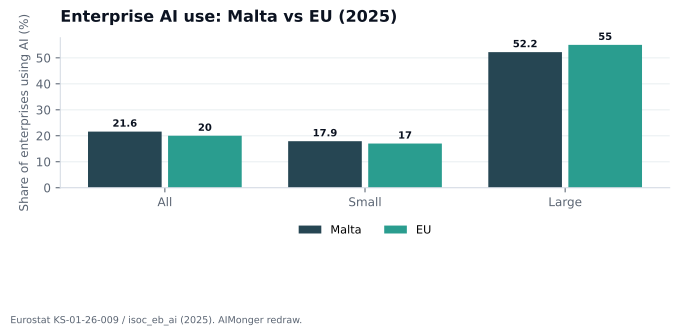
Figure 1. Enterprises using AI technologies, 2025, Malta versus EU average by size class. Plain read: Malta tracks the EU pattern, with large firms far ahead of small ones. In practice: a board of a 40-person professional services firm should not copy a large gaming group's tooling budget; it should copy the discipline of one named workflow with proof. Source: Eurostat, Use of AI in enterprises / KS-01-26-009 (2025). AIMonger redraw.
Evidence base: what the numbers prove
| Evidence | Finding | What it does and does not prove |
|---|---|---|
| Eurostat AI in enterprises 2025 | Malta 21.6%; EU 20.0% | Representative enterprise AI use (10+ employees); does not measure ROI or production depth |
| Eurostat by size (Malta 2025) | Small 17.9%; medium 30.7%; large 52.2% | Size correlates with use; does not prescribe a spend level |
| McKinsey State of AI 2025 | Widespread regular use; thinner EBIT impact; high performers more than 5% EBIT from AI | Global survey pattern on absorption; not a Malta census |
| Deloitte State of AI 2026 | Process redesign and mature operating models lag ambition (n=3,235) | Operating maturity gap; not Malta-specific sample |
| Stanford AI Index 2026 | Compiles adoption and productivity evidence; early agent production use | Synthesis, not independent triangulation of McKinsey’s 88% figure |
| Gartner newsroom (agentic) | Forecasts of agent features and project cancellation risk | Forecast, not Malta observation |
| MDIA / Malta AI Strategy 2030 | National strategy and oversight role for digital innovation | Policy intent; not enterprise spend guidance |
| Regulation (EU) 2024/1689 | AI Act obligations by role and risk | Legal floor; not a vendor shortlist |
Plain read: official statistics justify urgency. They do not justify an unscoped licence.
The three workflows that pay back first
Across gaming and betting operations, financial services, professional services, and organisations that sit next to public processes, the same bottlenecks appear. They are not unique to Malta, but they dominate mid-market time here because specialist headcount is scarce and compliance packs are frequent.
- Document-heavy approvals. Planning packs, client onboarding files, compliance submissions, and counsel reviews still move as email attachments and shared folders. AI helps when it extracts fields, checks completeness against a checklist, and drafts the cover note under a human gate. It fails when it is asked to “approve” without a named risk owner. A firm that cannot say which documents leave the building should not wire an open consumer tool into the pack.
- Cross-system reporting. Board packs assembled by hand from four to six systems burn senior analyst time every month. A tool loop that pulls governed extracts and drafts the narrative saves hours only if the source permissions and definitions are already clean. Otherwise the model accelerates wrong numbers. The spend decision is as much data ownership as model choice.
- Research and monitoring. Regulatory updates, competitor moves, and market notes are still assembled manually. Retrieval over a governed archive plus a critic pass on citations is usually enough. Crews of agents that browse the open web without allowlists create leak and hallucination risk that a small compliance team cannot absorb.
AI that shortens one of these cycles with a published before-and-after metric is worth more than a general-purpose chatbot seat for every employee.
Workflow diagnosis means: listing the steps, systems, handoffs, and failure modes of a process before choosing a model or vendor. On Monday: “client onboarding pack assembly” with minutes per step, systems touched, and who signs, written on one page before any demo.
Human gate, put simply: a named person who must approve before a consequential output leaves the firm or updates a system of record. Operating case: the model drafts the SAR response; counsel or the DPO releases it.
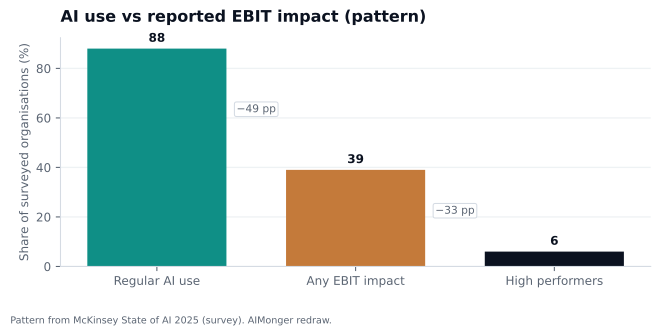
Figure 2. Illustrative absorption pattern: regular AI use is common; reported EBIT impact is thinner; high performers attributing more than 5 per cent of EBIT to AI remain a small cohort. In short: access is not impact. In practice: a Malta board should fund redesign of one workflow, not celebrate licence activation rates. Source: pattern from McKinsey State of AI 2025 (survey). AIMonger redraw of the published shape, not a Malta-only sample.
Operating implications for a small market
Spend that usually fails
- Seat-count theatre. Buying enterprise chat for everyone before naming three workflows spreads tokens and attention without creating an owner. Finance sees a rising line. Operations see the same bottlenecks. The board hears “we adopted AI” and cannot find a cycle-time chart.
- Vendor-led transformation. A deck that opens with “AI transformation” and never names a process is a marketing object. In a relationship market, it also becomes a peer warning when the pilot ends without metrics.
- Shadow tools under prohibition. When the official path is too slow, staff open personal accounts. That is often riskier than a managed EU-region endpoint with logging. Funding a usable official path is cheaper than pretending bans are controls.
- Agent fashion without a holdout. Multi-agent crews look modern. They multiply cost and failure modes. Most Malta mid-market workflows should stop at a tool loop plus critic until a frozen test set proves otherwise.
Spend that usually works
- One workflow, one metric, one owner. Publish the baseline, the target, and the person accountable. Review at thirty and ninety days. Kill or redesign if the metric does not move.
- Data boundary before cleverness. Map what may leave the building, what stays in-region, and what never leaves a private path. Malta’s regulated and IP-sensitive sectors need this map early; the EU AI Act and GDPR make vague placement expensive later.
- Evaluation as a budget line. Frozen examples of good and bad outputs cost little next to a year of seats. They are how you know a vendor upgrade did not quietly degrade quality.
- Training for the people who touch the work. Executives who approve budgets are not the people who run the workflow. The analysts who assemble packs need the playbook, the escalation path, and permission to refuse bad outputs.
National strategy versus board spend
Malta published an early national AI strategy (Strategy and Vision for Artificial Intelligence in Malta 2030), with the Malta Digital Innovation Authority in an oversight and facilitation role. Strategy realignment work has continued as technology and regulation moved. National programmes matter for skills, trust frameworks, and public-sector posture. They do not replace a board’s workflow decision.
Treat MDIA, MFSA (for financial services), and EU-level rules as context for risk class and evidence, not as a shopping list. A firm that waits for the next national funding call before fixing onboarding packs is waiting for the wrong starting gun.
| Layer | Who owns it | Board question |
|---|---|---|
| National strategy / MDIA | Public institutions | Are we aligning skills and trust expectations, or waiting for subsidies to think? |
| Sector supervisor (e.g. MFSA where relevant) | Regulated entities | Does this workflow touch supervised activity or customer outcomes? |
| EU AI Act / GDPR | Deployers and providers by role | What risk class is this use, and what evidence file exists? |
| Firm operating model | CEO / CIO / CTO | Which workflow, metric, owner, and placement path? |
Plain read: policy sets the floor. The board still chooses the first euro of spend.
Counter-position
Another board might argue that general chat licences are a cheap literacy investment and that workflow projects can wait until staff are comfortable. That position can be right for a short, capped literacy window with clear data rules and no connection to systems of record.
The counter fails when licences become the programme. Unscoped chat is how token bills grow and how sensitive files leave through the side door. Literacy without a second-phase workflow plan is how Malta firms recreate the global pattern of high use and thin EBIT impact. Cap the literacy window. Require a workflow proposal to unlock the next budget tranche.
Decision criteria before spending (board-ready)
- Name three candidate workflows in one page each. Steps, systems, weekly hours, failure modes. If the room cannot agree on three, do not buy seats.
- Pick one pilot with a holdout metric. Cycle time, manual hours, or error rate, measured before go-live. No metric, no purchase order.
- Assign a single accountable owner. Not “the digital team.” A named human who reports to the steering pack.
- Publish the data boundary. What may use metered APIs, what needs private managed endpoints, what needs dedicated or stricter paths. Refuse consumer accounts for firm data.
- Require a human gate for consequential outputs. Customer, regulator, or ledger-facing text needs a signer.
- Demand evaluation artefacts in the contract. Sample prompts, expected outputs, and a right to re-test after model changes.
- Set a kill date. Ninety days to show movement or stop. Sunk-cost renewal is how small markets burn two budget cycles on the same stall.
- Report in peer language. When the board asks “what did we get?”, answer with a workflow story a peer CEO would recognise, not with token counts.
FAQ
Should we wait for clearer EU AI Act guidance before any pilot? No. Wait for clarity on high-risk classification for the specific use. Low-sensitivity internal drafting with a human gate can proceed with basic inventory and logging while legal maps the harder cases.
Are gaming and financial services special cases? They are higher-scrutiny environments for customer and regulatory evidence, not exemptions from workflow discipline. The first pilot should still be a concrete pack or report cycle with a gate.
Is on-prem required? Only when the data class and risk appetite say so. Many firms will start with EU-region managed endpoints and strict contracts. Residency is not the same as control; read the retention and training-use clauses.
How does this relate to agentic systems? Most boards here should master a single tool loop with evaluation before funding crews. Agentic fashion without proof is a cancellation risk Gartner-style forecasts have already flagged globally.
References
- Eurostat, “20% of EU enterprises use AI technologies” (11 December 2025). https://ec.europa.eu/eurostat/web/products-eurostat-news/w/ddn-20251211-2
- Eurostat, “The use of artificial intelligence (AI) technologies in the European Union” (KS-01-26-009, 2026). https://ec.europa.eu/eurostat/documents/7870049/23260410/KS-01-26-009-EN-N.pdf
- Eurostat, “Use of artificial intelligence in enterprises” (Statistics Explained; data code isoc_eb_ai). https://ec.europa.eu/eurostat/statistics-explained/index.php?title=Use_of_artificial_intelligence_in_enterprises
- Eurostat, “Digital economy and society statistics - enterprises” (cloud and related ICT use). https://ec.europa.eu/eurostat/statistics-explained/index.php?title=Digital_economy_and_society_statistics_-_enterprises
- McKinsey & Company / QuantumBlack, “The State of AI: Global Survey 2025.” https://www.mckinsey.com/capabilities/quantumblack/our-insights/the-state-of-ai
- Deloitte AI Institute, “The State of AI in the Enterprise: The Untapped Edge” (2026 edition). https://www.deloitte.com/us/en/what-we-do/capabilities/applied-artificial-intelligence/content/state-of-ai-in-the-enterprise.html
- Stanford HAI, “The 2026 AI Index Report.” https://hai.stanford.edu/ai-index/2026-ai-index-report
- Gartner, “Gartner Predicts Over 40% of Agentic AI Projects Will Be Canceled by End of 2027,” press release, 25 June 2025. https://www.gartner.com/en/newsroom/press-releases/2025-06-25-gartner-predicts-over-40-percent-of-agentic-ai-projects-will-be-canceled-by-end-of-2027
- Malta Digital Innovation Authority (MDIA). https://mdia.gov.mt/
- Malta / Malta.AI, “Malta: The Ultimate AI Launchpad - A Strategy and Vision for Artificial Intelligence in Malta 2030” (PDF via Wayback). https://web.archive.org/web/20250716023102/https://malta.ai/wp-content/uploads/2019/11/Malta_The_Ultimate_AI_Launchpad_vFinal.pdf
- GovInsider, “Malta gave every citizen AI. Now what?” https://govinsider.asia/intl-en/article/malta-gave-every-citizen-ai-now-what
- Regulation (EU) 2024/1689 (AI Act). https://eur-lex.europa.eu/eli/reg/2024/1689/oj
- Regulation (EU) 2016/679 (GDPR). https://eur-lex.europa.eu/eli/reg/2016/679/oj
- Malta Financial Services Authority (MFSA). https://www.mfsa.mt/
- OECD AI Principles. https://oecd.ai/en/ai-principles
- NIST, “Artificial Intelligence Risk Management Framework: Generative Artificial Intelligence Profile,” NIST AI 600-1 (July 2024). https://nvlpubs.nist.gov/nistpubs/ai/nist.ai.600-1.pdf
- ENISA, “Artificial Intelligence Cybersecurity Challenges.” https://www.enisa.europa.eu/publications/artificial-intelligence-cybersecurity-challenges
- OWASP GenAI Security Project, “OWASP Top 10 for Large Language Model Applications.” https://owasp.org/www-project-top-10-for-large-language-model-applications/
- FinOps Foundation, State of FinOps 2026. https://www.finops.org/insights/state-of-finops/
- European Commission, “AI Act” regulatory framework (implementation resources). https://digital-strategy.ec.europa.eu/en/policies/regulatory-framework-ai
- National Statistics Office (Malta). https://nso.gov.mt/