

The problem in one sentence
If your official AI path takes six months, shadow AI already won.
Shadow AI, plainly: staff using generative AI for work outside approved systems, often consumer accounts on company data. In practice: a proposal lands in a personal ChatGPT session because the internal assistant still needs a security review that started in January.
A policy PDF that says “no ChatGPT” without an approved alternative pushes usage into private phones and personal accounts, which is worse for auditability. In a mid-market firm, shadow AI often starts quietly: a proposal pasted into a consumer tool, a customer email drafted from a personal account, a policy question answered by whichever chatbot was open. Staff are not always trying to bypass the company. They are trying to finish work when the official path is slower than the job.
What you see globally right now is consumer AI setting the usability benchmark for corporate systems. Gartner’s mainstreaming of GenAI applications by 2026 means staff expect AI assistance as normal work infrastructure. McKinsey’s use figures show the expectation is already organisationally widespread. Shadow AI is the unmanaged slice of that wave. By July 2026 that wave also includes personal use of Chinese open-model apps and cheap foreign endpoints alongside ChatGPT. A ban that names only one US consumer brand while staff paste into DeepSeek or Qwen web UIs is incomplete inventory. The official path still has to win on latency for the top use cases, whether the shadow tool is American or Chinese.
Ban-only strategies fail
Boards that lead with prohibition without capacity increase secrecy. The superior control is policy plus a better official path for high-volume use cases, with clear data-class prohibitions for consumer tools.
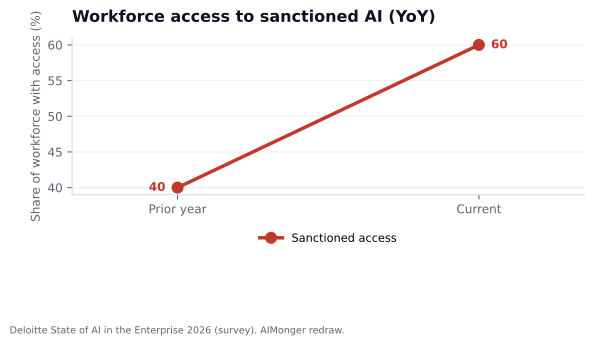
Figure 1. Approximate year-on-year rise in workforce access to sanctioned AI in Deloitte’s surveyed cohort. Plain read: official paths are expanding; gaps still feel slower than consumer tools. Worked case: access rose from roughly 40% to 60%; daily usefulness did not keep pace. Source: Deloitte State of AI in the Enterprise 2026 (survey). AIMonger redraw.
Deloitte 2026 reports workforce access to sanctioned AI rose about 50 percent in one year (from under 40 percent toward roughly 60 percent). Among those with access, daily workflow use remains incomplete in reported patterns. Unofficial tools can still feel more useful when training and UX lag.
Risk register (board view)
| Risk | Harm | Primary control |
|---|---|---|
| Confidential data in consumer tools | Leakage, contractual breach | Data-class ban + DLP + official alternative |
| Unlogged advice to customers | Inconsistent commitments | Mandatory official path for external drafts |
| Regulated data abroad | Residency and transfer issues | Contract review; prohibit classes 3-5 on consumer tiers |
| Model training on prompts | IP exposure depending on terms | Approved vendor terms only |
| No evaluation | Confident wrong answers | Discovery system with provenance |
Threat model (board concise)
| Threat | Pathway | Control |
|---|---|---|
| Confidential leakage | Paste into consumer AI | Data-class ban + DLP + official alternative |
| Unlogged customer advice | Personal tools for client work | Mandatory official path for external drafts |
| Training-use exposure | Vendor terms on consumer tiers | Contract review; prohibit for classes 3-5 |
| Inconsistent commitments | Multiple unofficial answers | Governed discovery with provenance |
| Audit failure | No inventory of tools | Amnesty inventory + continuous discovery |
NIST AI 600-1 recommends inventory, provenance, supplier assessment, and incident disclosure for GenAI. Unknown tools break inventory and incident processes.
Why official paths lose
Official tools lose when they are slower, less capable for the task, or buried behind tickets. Retirement of shadow AI is a product problem: ship a governed assistant that wins on latency and usefulness for the top three shadow use cases, then enforce.
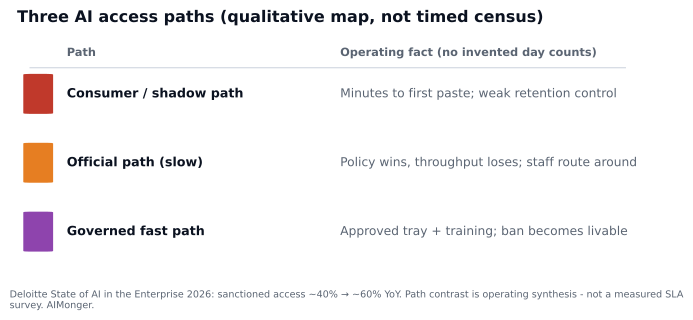
Figure 2. Three AI access paths as a qualitative map (no invented day counts). In short: consumer tools win on minutes; unmanaged official paths lose on quarters; governed fast paths make the ban livable. On Monday: measure your own mean time to approve a low-risk use case - do not cite a fake SLA chart. Source: Deloitte State of AI in the Enterprise 2026 (sanctioned access ~40% → ~60%). Path contrast is operating synthesis, not a timed census. AIMonger.
Retirement programme
- Amnesty inventory. Discover which tools staff actually use without punishment theatre so leadership ranks real shadow use cases instead of guessing from policy violations alone. The inventory replaces rumour with ranked volume, which is what lets the first sprint retire the use case that actually leaks, not the one the security team happens to have heard about. A firm that skips the amnesty and starts with DLP alerts alone will chase the loudest signal, not the highest-risk one.
- Data-class rules. Publish what may never leave approved systems so operators know before paste whether consumer AI is forbidden for client, regulated, or internal-strategy material. The rule has to be one page and written in the vocabulary staff use at work, because a policy nobody reads is functionally absent. Examples drawn from real daily tasks are what make a class 4 prohibition stick at 11 p.m. before a deadline.
- Fast path to approved tools. Ship a governed assistant for the top common tasks within weeks, not quarters, so the official route beats consumer latency for high-volume work. A sanctioned tool that is slower than the consumer alternative will lose every time, regardless of policy, because staff optimise for finishing the job. Winning on latency for the top three use cases is what makes retirement a product problem rather than a discipline problem.
- Training on safe paths and failure modes. Operators learn the approved workflow, override protocol, and escalation path so the sanctioned product feels easier than personal accounts, not harder. Training is what closes the gap between access and use, because a tool nobody can operate is shelfware even when it is officially deployed. Certification before access also prevents retirement from importing untrained operators into the replacement workflow.
- Proportionate monitoring. DLP and CASB alerts focus on highest-risk data classes so security gains visibility without driving secrecy through fear-based crackdowns alone. Monitoring that treats every employee as a suspect produces hiding, not compliance, which is the opposite of the visibility the control was meant to create. Feeding monitoring signals back into the amnesty inventory is what keeps the programme educational rather than purely punitive.
- Absorption into governed workflows. Move each high-volume shadow use case into a named workflow with owners, gates, and metrics so retirement is product delivery, not policy enforcement alone. A shadow use case that moves into a named workflow gains an owner, a metric, and a kill criterion, which are the three things a policy ban can never provide. Retirement is complete when the governed path owns the metric the shadow use case used to serve.
Eurostat’s adoption figures show many EU firms are early. Early is the moment to set norms before shadow patterns harden. the practical question is not whether staff can be frightened into abstinence. It is whether the sanctioned route is clear, quick, and useful enough to win the work back.
Discovery methods that do not destroy trust
- Anonymous surveys. Staff report tools and use cases without naming individuals so the amnesty inventory captures real patterns before DLP or procurement reviews begin. Anonymity is the precondition for honesty, because staff will not report a use case if reporting it risks their job. The survey is also the cheapest discovery method, since it costs no tooling and surfaces the use cases staff actually run at midnight.
- Browser extension and CASB signals. Where proportionate to risk, technical signals supplement self-report so leadership sees paste events and unsanctioned SaaS without treating every employee as a surveillance target. Technical signals catch what staff will not self-report, but they miss everything that happens on a personal phone outside the corporate network. Pairing signals with anonymous surveys is how you get coverage without destroying trust.
- Procurement card reviews for AI SaaS. Finance and IT scan card and invoice lines for AI subscriptions that never entered the inventory, which closes the gap between “we banned ChatGPT” and “we pay for three shadow copilots.” Card reviews catch the shadow tools that staff expense because the official path is too slow to provision. The review is also a leading indicator of where the governed fast path is losing to consumer tools on latency.
- Enablement-framed manager conversations. Managers ask what would make the official path win, not who to discipline, so honest use cases surface before incidents force a punitive review. The framing converts a manager from an enforcer into a product researcher, which is the role that actually retires shadow use. A conversation that starts with “what would help” surfaces use cases a conversation that starts with “who did this” never will.
Fear-based crackdowns increase secrecy. Exact shadow-AI prevalence is hard to measure because it is intentionally hidden. Use amnesty inventories, proportionate DLP/CASB signals, and procurement reviews. Treat prevalence estimates as directional management indicators, not courtroom facts.
Policy that staff can follow
One page, plain language:
- Allowed tools by data class. Each data class lists which approved assistants, corpora, and workflows may be used so staff never guess whether a paste is permitted at 11 p.m. before a deadline. A table of class against allowed tool is the single artefact that turns a vague policy into an actionable decision. Without it, staff default to “try it and hope,” which is how a class 4 client document ends up in a consumer session.
- Forbidden actions. Regulated and client-confidential material must not enter consumer AI tiers, with examples staff recognise from daily work rather than abstract legal definitions alone. A prohibition written in legal language is theatre; a prohibition written in the vocabulary of the queue is a control. The examples should come from the amnesty inventory, because those are the paste events staff actually perform.
- New use-case request path. A short form explains how to propose a governed alternative within days so innovation routes through the fast path instead of personal accounts. The form has to be shorter than the consumer tool’s sign-up flow, or the official path loses on friction before it loses on capability. A request path that takes a week to return a decision is a shadow-AI manufacturing process.
- Safe mistake reporting. Staff know how to report a harmful paste or wrong draft without fear of automatic termination, which keeps incidents visible instead of buried in private chats. A reporting channel that punishes honesty produces hiding, which is the exact opposite of the visibility the control was meant to create. The safest firms treat a self-reported paste as a learning event, not a disciplinary one.
If the policy is longer than staff will read, it will not be followed.
DLP and monitoring (proportionate, not theatrical)
DLP, in short: automated rules that detect sensitive data leaving approved systems; paste into consumer AI is a common trigger. Operating case: block class 4 client data from consumer AI domains; alert on class 3 internal strategy; allow class 1 public web research on approved tools.
DLP without an official alternative increases frustration and circumvention. Sequence matters: publish data classes, ship governed assistant, train operators, then tighten DLP on the highest-risk classes. Monitoring should feed the amnesty inventory, not only disciplinary cases.
Corporate telemetry studies (population-specific) have reported sensitive paste events into AI tools. Treat counts as directional risk indicators. The control is not perfect visibility; it is making the official path faster and safer for the top use cases.
Linking shadow AI to human capacity and permissions
Shadow AI rarely appears in isolation. It clusters where:
- Permission delays exceed a quarter. When governed read access takes months, staff photograph documents into consumer tools because the official retrieval path never arrives (see companion permissions paper). The photograph is the visible symptom; the cause is an access decision that nobody owns and nobody escalates. Retiring the shadow use requires a governed fast path, not a tighter ban on phone cameras.
- Training stops at town halls. Awareness sessions without operator certification leave the sanctioned tool harder to use than the consumer alternative staff already know (see companion human-capacity paper). A town hall raises awareness and changes nothing, because awareness without competency cannot retire a workflow. Certification before access is what makes the sanctioned tool the easier path.
- No executive sponsor with day-scale unblock authority. Without a sponsor who can approve low-risk patterns in days, security and IT become villains while the business quietly leaks data through personal accounts. The sponsor is the person who can say yes in days, which is the tempo consumer tools set. A programme without a sponsor defaults to no, and no is the answer that manufactures shadow AI.
Boards reviewing shadow AI should read the same steering deck as absorption and permissions. Retiring shadow use case #1 often requires a governed fast path for data access and certified operators for the replacement workflow.
Worked example: proposal drafting in professional services
Shadow pattern: Associates paste RFP sections into consumer AI for first drafts. Risk: Client confidential material in vendor logs; inconsistent commitments. Retirement path:
- Amnesty week surfaces the use case. Associates anonymously rank proposal drafting as the top shadow pattern so leadership retires volume, not hypotheticals, in the first thirty-day sprint. Ranking by volume, rather than by anecdote, is what stops the programme from retiring a use case a partner mentioned once while ignoring the one associates run every evening. The amnesty also establishes the baseline the retirement will be measured against.
- Class 4 client rule published. Client documents are class 4 with an explicit consumer-AI prohibition so DLP and policy align before the governed assistant ships. Publishing the rule first means DLP blocks and the replacement path share the same definition of forbidden, which prevents the common failure of a DLP rule that fires after the assistant already shipped. The rule also gives associates a clear answer when they are tempted to paste at 11 p.m.
- Governed assistant in thirty days. An approved corpus with logging goes live within thirty days so the official path can beat personal ChatGPT on latency for first drafts. Thirty days is the tempo that competes with consumer tools; a quarter is not. The assistant does not need to be better than the consumer tool on every task, only on the one task the amnesty ranked highest.
- Certification before client workflows. Production access on client-facing drafting requires certification on provenance, override, and data-class rules so retirement does not import untrained operators. Certification is what stops the retirement from creating a new incident class: a sanctioned tool operated badly. The gate also gives the trainer a checkpoint to retire curriculum that no longer matches the live workflow.
- Approval tempo metric under ten days. Median time to approve low-risk internal drafting use cases stays below ten days so the fast path remains credible after the amnesty window closes. A fast path that slows back to quarters after the first sprint is a signal that the programme treated amnesty as a one-off, not an operating model. The metric is also the evidence the risk committee uses to decide whether to tighten DLP or widen the governed path.
Every high-volume shadow use case is a candidate for the absorption portfolio. Steal the use case back into a governed path with better UX than the consumer tool for that job.
Sector overlays
- Professional services. Client confidentiality clauses often forbid consumer AI outright, so any document work requires an official path with logging before associates paste RFP sections into personal accounts. A firm that loses a client confidentiality claim because an associate pasted a draft into a consumer tier has lost more than a matter; it has lost the trust asset that funds the partnership. The official path has to be available before the clause is tested, not after.
- Finance, gaming, and health. Regulated data classes make shadow use an incident waiting to happen because residency, retention, and vendor terms on consumer tiers rarely satisfy sector expectations. In these sectors a paste is not a policy violation; it is a reportable event with a notification clock. The cost of a single shadow paste in a regulated firm can exceed the cost of building the governed path that would have prevented it.
- Public-sector-adjacent work. Procurement and transparency rules raise the cost of informal tools, so shadow AI becomes reputational risk the moment an unlogged draft reaches a regulator or tender response. A tender response drafted in a consumer session is an audit failure even if the text is correct, because the provenance cannot be reconstructed. The official path is the only one that survives a transparency request.
mid-market firms selling trust should treat shadow AI as brand risk, not only IT risk.
Incident severity classes
S1: regulated personal data or client confidential in consumer AI S2: external commitment issued from unlogged AI draft S3: internal policy answered incorrectly with business impact S4: policy violation without data exposure
Pre-assign notification owners for S1/S2.
Executive sponsorship
Name a sponsor who can unblock the official path in days. Without sponsorship, security and IT become the villains while the business quietly leaks data through personal accounts.
Evidence base: sanctioned access is rising, unmanaged use remains the residual risk
| Source | Finding | Risk reading |
|---|---|---|
| Deloitte 2026 | Workforce access to sanctioned AI rose ~50% YoY in surveyed cohort | Official paths expanding; gaps remain |
| Deloitte 2026 | Daily workflow use incomplete among those with access | Unofficial tools still feel more useful |
| NIST AI 600-1 | Inventory, provenance, supplier assessment recommended | Unknown tools break incident processes |
| Eurostat / EU AI Act | Formal enterprise AI use and regulatory expectations rising | Shadow processing of regulated data is legal and brand risk |
| Microsoft Work Trend Index | Large share of surveyed AI users used non-company tools | State denominator: AI users, not all workers |
Plain read: Microsoft and LinkedIn workforce research has reported that a large majority of surveyed AI users, not of all workers, brought tools not supplied by their organisation. Always state the denominator.
Methodology note
Telemetry studies of sensitive data pasted into AI tools can be directionally useful but are population-specific. Paste remains a common exfiltration path in published corporate telemetry, which is why data-class bans and DLP matter alongside official alternatives.
Counter-position: bans are simpler
Another board might argue that a clear ban is easier to communicate than building alternatives. Bans without a fast approved alternative increase secrecy and personal-account usage. The superior control is policy plus a better official path for high-volume use cases.
Risk committee decision criteria
- Completed amnesty inventory with ranked use cases. The committee receives a ranked top-three shadow use case list from amnesty week so retirement funding targets volume, not vendor demos alone. Ranking converts an emotional security debate into a prioritisation exercise the committee can fund. An inventory that does not exist is the clearest signal that the risk committee is governing rumour, not risk.
- One-page data-class policy live. Plain-language rules on allowed tools and forbidden pastes are published so enforcement and enablement share the same document staff actually read. A policy longer than one page will not be read, which means it will not be followed, regardless of how correct it is. The one-page constraint is what forces the policy to name the real use cases instead of covering every hypothetical.
- Governed fast path within thirty days. At least one high-volume use case from the inventory receives a replacement path within thirty days so the programme proves speed, not only policy. Thirty days is the tempo that competes with consumer tools; a quarter is not. Shipping one replacement also tests whether the governed path can win on latency, which is the question that determines whether retirement is possible at all.
- Measured low-risk approval tempo. Median time to approve a new low-risk use case is tracked and reported so the board can compare official latency against shadow incident cost. The metric reframes approval speed as a control, not an enablement nicety, because a slow approval is a shadow-AI manufacturing process. A rising median is the earliest signal that the fast path is reverting to a serial questionnaire.
- Data-class training completion. Affected roles complete training on data classes before production access expands, which prevents retirement from outrunning operator competence. Training completion is the gate that stops a governed path from creating a new incident class: a sanctioned tool operated by someone who does not know the data rules. Without the gate, the retirement trades shadow risk for sanctioned risk.
- Named S1 and S2 incident owners. Regulated-data and external-commitment incidents have pre-assigned owners so the first paste into consumer AI triggers response instead of a committee debate. Pre-assignment is what turns a severity class from a label into a response, because the owner exists before the incident rather than being nominated during it. The first hour of a regulated-data leak determines whether it is contained or escalated.
- Quarterly directional unapproved-use metric. Estimated unapproved tool use is reported directionally each quarter so the risk committee sees whether retirement is winning back work. The metric is directional, not precise, because shadow use is intentionally hidden, but a trend is still actionable. A flat or rising estimate is the signal to widen the governed path rather than tighten the ban.
Metrics for the risk committee
- Estimated unapproved-tool use. Directional estimates of knowledge workers on unsanctioned tools show whether retirement is shrinking the shadow surface or only driving it deeper underground. The metric is directional because shadow use is hidden, but a trend is still actionable where a snapshot is not. A falling estimate paired with rising governed-path usage is the signal that retirement is winning.
- Mean time to approve low-risk use cases. Approval tempo proves whether the official path can compete with consumer tools on the jobs staff actually run at midnight before a deadline. A median measured in days competes with consumer tools; a median measured in weeks does not. The metric also identifies the bottleneck, whether it is security, data-class declaration, or business-owner absence, before it stalls the programme.
- Governed alternatives launched. Count replacement paths shipped per quarter so the committee funds product delivery alongside DLP and policy updates. The count distinguishes a programme that ships from one that writes policy, and the board needs to see both. A quarter with zero replacements and three new policy pages is a programme that is losing to the consumer tools.
- Data-class training completion. Completion rates by role show whether staff can follow the one-page policy when paste temptation is highest during peak workload. Completion is a process metric, but paired with the unapproved-use estimate it becomes evidence of whether training is changing behaviour. A high completion rate with flat unapproved use suggests the training is awareness, not competency.
- GenAI-related incidents. Incidents involving generative AI tools feed severity review and retirement priorities instead of living only in IT ticket backlogs. An incident count above zero is not necessarily bad, because an incident that is reported is one the programme can learn from. An incident count of zero on a system with no telemetry is the real warning sign.
Appendix: amnesty week script
- Announce safer, faster official AI. Leadership frames amnesty week as enablement, surfacing use cases to replace, not a trap for discipline, so honest reporting beats hidden paste behaviour. The framing matters because staff will not report a use case if reporting it puts their job at risk. Announcing the replacement path in the same breath as the amnesty is what makes the offer credible.
- Collect use cases and tools. Anonymous channels capture which consumer tools and workflows staff rely on so the inventory reflects Monday-morning reality, not IT assumptions alone. The channel has to be genuinely anonymous, because a survey that can be traced back to an individual will underreport the highest-risk use cases. The inventory is the baseline the retirement will be measured against, so a thin inventory produces a thin programme.
- Triage into allow, replace, and forbid. Each reported pattern receives a decision within the working session so staff see governance responding at business tempo, not quarter-long silence. The triage is where the programme earns or loses trust, because a decision returned in hours proves the fast path is real. A decision deferred to a committee that meets monthly is a signal that the official path cannot compete with the consumer tool.
- Publish decisions in five working days. Allow, replace, and forbid outcomes go live within five working days so trust in the official programme survives the amnesty window. Five days is the tempo that competes with consumer tools; a month is not. Publishing the decisions also closes the loop with staff who reported, which is what makes the next amnesty credible.
- Ship one replacement within thirty days. At least one replace decision becomes a governed path within thirty days so retirement is credible before shadow habits re-harden. One replacement is the minimum that proves the programme can ship, not only write policy. A quarter with zero replacements after an amnesty is a programme that has lost the trust the amnesty earned.
Closing position
Shadow AI is a leading indicator of absorption failure.
Boards should treat it as a capacity and trust problem, then fund the official path that makes the shadow unnecessary.
References
- Deloitte AI Institute, “The State of AI in the Enterprise: The Untapped Edge” (2026 edition); survey of 3,235 leaders, Aug-Sep 2025. https://www.deloitte.com/us/en/what-we-do/capabilities/applied-artificial-intelligence/content/state-of-ai-in-the-enterprise.html
- NIST, “Artificial Intelligence Risk Management Framework: Generative Artificial Intelligence Profile,” NIST AI 600-1, July 2024. https://nvlpubs.nist.gov/nistpubs/ai/nist.ai.600-1.pdf
- Eurostat, “20% of EU enterprises use AI technologies,” 11 December 2025 (20.0% in 2025; 13.5% in 2024). https://ec.europa.eu/eurostat/en/web/products-eurostat-news/w/ddn-20251211-2
- Regulation (EU) 2024/1689 of the European Parliament and of the Council (EU AI Act). https://eur-lex.europa.eu/eli/reg/2024/1689/oj
- Gartner, “Gartner Says More Than 80% of Enterprises Will Have Used Generative AI APIs or Deployed Generative AI-Enabled Applications by 2026,” press release, 11 October 2023. https://www.gartner.com/en/newsroom/press-releases/2023-10-11-gartner-says-more-than-80-percent-of-enterprises-will-have-used-generative-ai-apis-or-deployed-generative-ai-enabled-applications-by-2026
- McKinsey & Company / QuantumBlack, “The State of AI: Global Survey 2025.” https://www.mckinsey.com/capabilities/quantumblack/our-insights/the-state-of-ai
- Microsoft Work Trend Index / LinkedIn workforce AI survey materials. https://www.microsoft.com/en-us/worklab/work-trend-index
- ENISA publications on AI cybersecurity. https://www.enisa.europa.eu/topics/artificial-intelligence
- OWASP Top 10 for LLM Applications. https://owasp.org/www-project-top-10-for-large-language-model-applications/
- Gartner, “Gartner Predicts Over 40% of Agentic AI Projects Will Be Canceled by End of 2027,” press release, 25 June 2025. https://www.gartner.com/en/newsroom/press-releases/2025-06-25-gartner-predicts-over-40-percent-of-agentic-ai-projects-will-be-canceled-by-end-of-2027