

The problem in one sentence
If you fund models without funding trust, apprenticeship, and anxiety management, you are buying theatre that your own people will either resist, hide, or burn cash on.
The marriage of psychology, AI, and business is no longer a soft-skills appendix. It is the operating layer that decides whether licences become surplus. Deloitte’s 2026 human-capital work calls the unpaid bill cultural debt: norms, fairness questions, and trust erosion that accumulate when organisations ship AI for efficiency while ignoring what the tools do to human-to-human behaviour. In the same season, US graduates booed commencement speakers for mentioning AI, Chinese courts told employers they cannot fire people simply because an AI can now do the job, Gulf states chased cheap energy for data centres while writing governance rulebooks, and France doubled down on Mistral as a sovereignty instrument. These are not separate news cycles. They are one system under stress.
Cultural debt, plainly: the backlog of trust, fairness, authorship, and connection problems an organisation accumulates when it adopts AI without redesigning norms and accountability. On Monday: a team ships an AI drafting tool; within a quarter, managers stop believing status reports and juniors stop showing unfinished work because both sides assume the other is performing productivity.
Psychological safety (AI context) means: people can disclose when they used a model, when it failed, and when they disagree with an automated recommendation, without career punishment for honesty. Worked case: a claims reviewer can flag a wrong model suggestion and keep their performance rating, instead of rubber-stamping to look fast.
Cross-read the capacity and surplus papers in this series for the adjacent mechanics: Human capacity is the AI operating model, Absorption capacity, and The AI productivity paradox. This paper sits upstream of those: the psyche and the labour market that decide whether any of that operating design can stick.
The zeitgeist signal: boos as market research
Spring 2026 turned university auditoriums into a public opinion instrument.
At the University of Central Florida, a real-estate executive called AI the next industrial revolution and was met with a chorus of boos before the room later softened. At Middle Tennessee State University, a music-industry executive was heckled for saying AI is rewriting production. At the University of Arizona, former Google CEO Eric Schmidt was repeatedly booed when he framed AI as inevitable and asked graduates to help shape it. NPR, NBC, SiliconANGLE, and El País treated those events as a class-of-2026 mood around AI cheerleading and employment anxiety, not a one-campus stunt.
Do not blend every commencement protest into one AI story. Some events were principally about AI and jobs. Others mixed corporate politics and government relationships. TechCrunch’s report on Sundar Pichai at Stanford explicitly framed that walkout around Google’s Israel and ICE ties, not principally fear of AI replacing graduate jobs. The reusable fact is narrower and still hard: large cohorts of new graduates are emotionally mobilised against naive AI optimism, while some high-profile protests also target specific corporate and government relationships.
El País cited a Gallup reading published in April 2026: Gen Z enthusiasm for AI had fallen fourteen points to 22 per cent, anger had risen nine points to 31 per cent, and anxiety sat near 42 per cent. That is survey colour, not a census of every graduate. It is enough to tell a talent committee that cheerleading slides will land as tone-deaf.
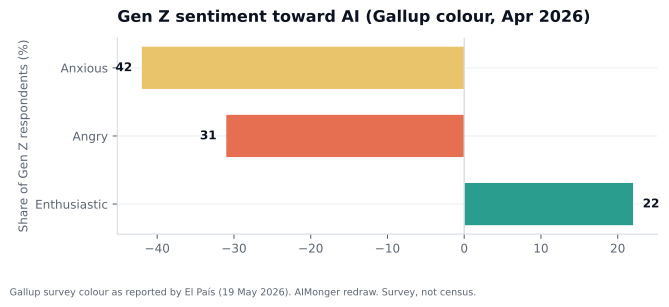
Figure 1. Reported Gen Z sentiment toward AI in the Gallup reading summarised by El País (April 2026 coverage). Plain read: anxiety and anger now outweigh enthusiasm in the pipeline that feeds entry-level hiring. Operating case: a graduate onboarding pack that opens with "AI will transform everything" is already behind the emotional facts in the room. Source: Gallup survey colour as reported by El País English, 19 May 2026 ([https://english.elpais.com/technology/2026-05-19/generational-rejection-of-ai-why-are-university-students-booing-big-tech-at-graduation-ceremonies.html](https://english.elpais.com/technology/2026-05-19/generational-rejection-of-ai-why-are-university-students-booing-big-tech-at-graduation-ceremonies.html)). AIMonger redraw. Survey, not census.
The boos are rational in labour-market terms even when they are messy in politics. Washington Monthly’s May 2026 analysis linked commencement rage to a weaker entry-level ladder: some posting mixes shifted toward heavier experience requirements, and the four-year degree looks valuable but insufficient when employers want proof of prior work. The St. Louis Fed’s June 2026 note is careful: broader declines in job openings still explain more of young-worker softening than AI demand alone, but rising AI-related skill requirements independently raise the bar for new entrants. Strada’s employer survey finds a mixed picture in which many talent leaders still expect AI to increase, not erase, entry-level hiring, while shifting tasks away from routine administration. The honest synthesis is uncomfortable. AI is not the only headwind. It is a visible headwind that graduates can name, and naming it out loud now has social permission.
Psychology meets the invoice: tokenmaxxing anxiety
Anxiety is not only generational. It is financial and status-based inside the firm.
Industry commentary under the label tokenmaxxing describes cultures that treat token volume as proof of seriousness until the invoice arrives as discovery. The FinOps Foundation’s State of FinOps 2026 finds that 98 per cent of surveyed practitioners now manage AI spend. That is the market admitting that metered cognition broke seat-based predictability. Cross-read The cost of privacy and Model routing and cost governance for the cash mechanics. The psychological point here is different. Unbounded meters create two anxieties at once: finance fears an uncontrollable OpEx spike, and ambitious staff fear looking obsolete if they do not burn tokens in public.
Tokenmaxxing anxiety, put simply: the dual fear that the organisation will overspend on metered AI while individuals under-perform socially if they do not maximise visible AI use. On the P&L: a team races to show agent loops in every weekly update; finance sees a spike with no outcome tag; both sides lose trust in the programme.
Deloitte’s cultural-debt work reports that 80 per cent of surveyed leaders, managers, and workers worry colleagues use AI to appear more productive than they are. That is a status economy problem. When authorship is blurred, psychological safety collapses, and people either hide AI use (shadow tools) or perform AI use (token theatre). McKinsey’s workplace research finds employees often trust their own employer more than big tech to deploy AI ethically, while roughly half still worry about inaccuracy and cyber risk. Trust is available. It is also perishable.
- Fear of replacement. Workers and graduates hear both apocalyptic and walked-back forecasts from lab leaders, then watch entry-level posting mixes tighten, so the emotional system stays on high alert even when macro data is mixed. The leadership mistake is to answer fear with slogans. The operating answer is a published apprenticeship map that shows which junior tasks remain, which move to AI, and how judgement is still taught.
- Fear of looking stupid. People hide weak prompts, wrong answers, and tool dependence because performance systems still reward polished output over honest process. Without disclosure norms, evaluation data dies and shadow AI grows. A firm that punishes visible failure teaches private failure.
- Fear of the invoice. Metered agents multiply retries and tool calls overnight, so a culture that celebrates volume creates surprise bills and then sudden crackdowns that feel arbitrary. Ceilings without routing become quality cliffs. Routing without storytelling becomes a police state. Finance and talent need the same narrative.
- Fear of unfair authorship. When nobody knows who did the work, trust between peers decays faster than any model accuracy metric can repair. Cultural debt is the name for that decay. Paying it down requires rituals: disclosure tags, review gates, and praise for catching model errors.
Three labour psychologies: United States, Europe and Malta, China
The same technology is landing in three different emotional economies.
United States: the blocked first rung
US discourse in mid-2026 is dominated by the entry-level squeeze. Graduates boo because the historic bargain (tuition for a first professional rung) feels broken. Employers raise the bar toward AI-ready problem solving and prior experience at the same moment that some of the old scaffold tasks are automated. Recruiter surveys claiming large shares of entry roles are being replaced by AI should be labelled surveys, not labour statistics. The St. Louis Fed’s caution matters: the business cycle still dominates. Politically and psychologically, that nuance often loses to the simpler story that AI ate the first job. Firms hiring in the US should assume candidates arrive primed for distrust of AI cheerleading and should lead with concrete pathway design instead.
Europe and Malta: skills scarcity, compute scarcity, quieter rage
The EU pattern is different. Eurostat reports that 20.0 per cent of EU enterprises with ten or more employees used AI in 2025, up from 13.5 per cent in 2024. Among people aged 16 to 74, 32.7 per cent used generative AI tools in 2025, with Malta near the top at 46.5 per cent. Consumer and SME curiosity is not the bottleneck. Depth is. The European Investment Bank’s Maltese firm survey finds innovation confidence alongside a brutal skills constraint: 93 per cent of firms cite skills shortages as a barrier, with 76 per cent calling them a major barrier, far above the EU average. Energy costs also weigh heavily. Cross-read AI adoption for Malta boards for the local operating picture.
European and Maltese students face a quieter trap than US graduates. The job market is often constrained by SME scale and specialist shortages rather than by a Silicon Valley narrative of mass white-collar erasure. The learning trap is cost and access. Agentic AI, meaning systems that plan, call tools, and iterate overnight, is expensive to practise at production fidelity. RAND and Commission-adjacent analyses of Europe’s compute gap describe fragmented capacity, power bottlenecks, and slower access for researchers and smaller institutions compared with US hyperscaler density. Elite US universities and MIT-linked programmes such as Universal AI and PATH can wrap agentic curricula, industry partners, and subsidised pathways at a scale most European and Maltese faculties cannot match week to week. That is not a talent deficit. It is an infrastructure and purchasing-power deficit that shows up later as an absorption deficit inside firms.
France’s answer is partly industrial psychology: make sovereignty feel like agency. The French and German governments’ partnership with Mistral AI and SAP for sovereign public-administration AI, with a binding framework agreement targeted for mid-2026, is a state-level attempt to convert anxiety about US and Chinese stack dependence into a controllable European story. Arthur Mensch’s public line that Europe must own its AI future from infrastructure to technology is political theatre with an operating core. Mid-market leadership teams should borrow the control questions, not wait for a national model to solve their Monday workflow. Deeper placement and privacy economics sit in Sovereign versus managed inference and The cost of privacy.
China: labour law as anti-fearmongering, posture and substance
Chinese courts in Hangzhou and Beijing have held that voluntary AI adoption is not an unforeseeable “objective major change” that alone justifies dismissal under Article 40(3) of the Labour Contract Law. That is a real labour-law constraint and political signal, not a blanket statutory ban on all AI-related restructuring. Employers are pushed toward retraining, reasonable redeployment, or properly grounded collective procedures, not a one-line “the bot replaced you” letter. Caixin, China Law & Practice, and Taylor Wessing all read the cases that way. MOHRSS has also signalled a 2026 implementing document on AI’s employment impact, and political proposals have floated employment-impact assessments before large AI-replacement plans.
Is this posture or real constraint? Both, and operators in China should plan for both.
It is real because specific employers lost cases and owed compensation, which changes counsel advice and HR playbooks inside the PRC. It is posture because the state still wants AI-driven productivity, still runs a political economy that values stability, and has not enacted a cartoon ban on all AI-related restructuring. The signal to global leadership teams is still sharp. Beijing is treating AI-replacement fear as a social-stability risk that courts and ministries can dampen. Washington’s graduates boo. China’s workers litigate. Europe’s workers often hit skills and compute walls first. Same technology, different emotional institutions.
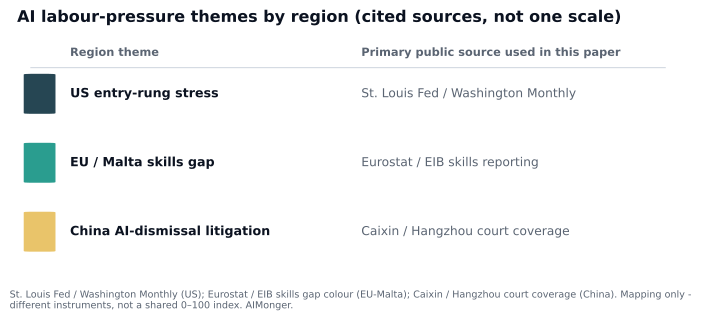
Figure 2. Regional AI labour-pressure themes mapped to the public sources used in this paper (keymap - not a shared 0–100 intensity index). The point: US discourse centres on the blocked entry rung; Europe and Malta centre on skills and compute access; China's court signal centres on unlawful AI-only dismissals. Reading: do not invent a common scale across different instruments. Source: St. Louis Fed / Washington Monthly (US); Eurostat / EIB (EU-Malta); Caixin and Hangzhou court coverage (China). AIMonger mapping.
The Gulf: cheap electrons, expensive trust
Gulf AI strategy was sold as energy arithmetic. Abundant power, sovereign capital, and geography within reach of multiple continents made the UAE, Saudi Arabia, and Qatar plausible homes for hyperscale inference. CNBC’s May 2026 reporting on the regional conflict stress-tested that pitch: attacks on data-centre assets, higher insurance and hardening costs, and a war-risk premium against the earlier story of industrial electricity near eleven US cents per kilowatt-hour. The opportunity has not vanished. It has been repriced.
At the same time, Gulf governments are writing governance appetite into institutions. Saudi Arabia’s SDAIA frameworks and Year of Artificial Intelligence messaging, the UAE’s ethics charter and June 2026 federal AI and data authority consolidation, and central-bank guidance for supervised AI in finance all point the same way. Capital wants trusted deployment, not only cheap kilowatt-hours. For European firms partnering into Gulf compute or markets, the psychology lesson is practical. Counterparties will ask for sovereignty, human oversight, and residency stories because their political economy demands them. Cheap energy without a trust narrative is now incomplete product design.
Education, agentic practice, and the MIT advantage
Hiring managers often ask why new hires “do not know agents.” The answer is partly curriculum. It is mostly cost.
To learn agentic systems seriously, a student needs repeated contact with tool-calling loops, evaluation failures, logging, and non-trivial token or GPU budgets. Chat demos are cheap. Overnight crews are not. MIT Open Learning’s Universal AI programme and the MIT RAISE PATH collaboration with Georgia State and community colleges show what concentrated US academic capital can do: modular fluency paths, agentic AI coursework, and industry-aligned training at a scale that smaller European and Maltese institutions struggle to fund continuously. MIT itself is also publishing research on cutting agent compute and energy waste, which is another way of saying the cost problem is real enough for top labs to attack it as science.
Europe’s AI Factories and related EuroHPC efforts are the public answer to the access gap. They matter. They are also slower and more fragmented than a campus that can put a credit card against a frontier API and a research cluster in the same afternoon. Firms that need agent-ready juniors in Malta or smaller EU markets should stop waiting for universities alone. Fund internal sandboxes with ceilings, paired seniors, and disclosure norms. That is psychology and capital allocation in one decision. Strategic patience is the tempo paper; this is the talent-formation paper.
Evidence table: what the numbers prove and do not prove
| Claim | Evidence type | What it supports | What it does not prove |
|---|---|---|---|
| Class of 2026 public hostility to AI cheerleading | Journalism + Gallup colour | Emotional mobilisation in the US talent pipeline | That every graduate opposes AI tools at work |
| Entry-level ladder under stress | Fed research + labour analysis | AI raises skill bars; openings cycle still dominates | That AI alone caused youth unemployment |
| Cultural debt and fake productivity fears | Deloitte HCT 2026 survey | Trust and authorship are breaking inside firms | Exact financial loss per firm |
| Malta/EU skills vs curiosity gap | Eurostat + EIB | High GenAI curiosity; severe skills barrier for firms | That Maltese students refuse AI |
| China AI-dismissal rulings | Court cases + legal commentary | AI-only firing is legally risky in PRC | A total ban on AI-related restructuring |
| Gulf energy advantage under stress | Journalism + policy synthesis | Cheap power was real; war-risk repriced it | That Gulf AI build-out stops |
| Franco-German Mistral sovereignty push | Official press | State psychology of control and procurement | That mid-market firms inherit a ready stack |
Plain read: use the table to kill global slogans. Every region has a different primary emotion and a different primary constraint.
Operating implications: psychology as infrastructure
- Publish an AI apprenticeship map before the tool catalogue. Show which junior tasks remain human, which become AI-assisted, and how review teaches judgement, so the first rung is redesigned rather than quietly deleted. Without the map, US-style fear and EU-style skills complaints both intensify inside the same workforce. The map is a talent product, not an HR poster.
- Price anxiety in the same pack as tokens. Pair monthly token ceilings and task routing with disclosure norms and anti-theatre rules so volume cannot become a status game. Finance should see outcome tags; talent should see praise for catching model errors. One narrative prevents the programme from oscillating between tokenmaxxing and panic cuts.
- Treat cultural debt like technical debt. Schedule rituals that restore authorship clarity: AI-use tags on work products, random audit samples, and manager training on evaluating process rather than polish alone. Deloitte’s finding that many organisations are not evaluating AI’s impact on people is a governance gap, not a vibes gap. What is unmeasured becomes unmanageable.
- Localise the fear story. In US hiring markets, lead with pathway honesty. In Malta and smaller EU markets, lead with skills access and compute sandboxes. In China operations, lead with lawful redeployment and documentation. In Gulf partnerships, lead with governance and residency evidence beside power economics. Copy-pasted change decks are how global programmes create local distrust.
- Borrow sovereignty language without waiting for flags. France and Mistral show how political psychology converts dependence anxiety into procurement. Firms can run the same conversion at operating scale by naming which workflows need private or in-region inference and which can stay on metered APIs. Control questions beat national slogans for the Monday decision.
Counter-position
Another leadership team might argue that psychology is a communications problem, that labour markets will clear, and that the winning move is still to buy the best models fastest while HR runs a webinar. That position can be right for a short window in a firm with scarce competition for talent and low regulatory exposure.
The counter fails when graduates arrive already primed to reject slogans, when managers stop trusting output authorship, when token invoices arrive without outcome tags, and when regional labour rules or sovereignty politics punish naive deployment. Speed without psychological operating design does not compound. It accumulates cultural debt that later shows up as shadow AI, attrition, and programmes that finance refuses to renew. Shadow AI is the failure mode when trust collapses into private tooling.
Decision criteria for leadership and talent
- Name the emotional risk by region and cohort. US campus hires, Maltese operators, China-based staff, and Gulf partners do not share one fear script. The operating brief should say which fear is load-bearing where.
- Require an apprenticeship redesign with the first production workflow. No AI go-live that deletes junior scaffold without a replacement learning path and named reviewers.
- Put token ceilings, routing, and anti-theatre rules in one finance-talent memo. Volume cannot be a KPI. Outcomes and honest disclosure can.
- Measure cultural debt quarterly. Authorship clarity, willingness to report model errors, shadow-tool incidence, and manager trust in AI-assisted work. If those metrics are absent, the programme is flying blind on the human layer.
- Fund practice compute for learners, not only production GPUs. Internal sandboxes with budgets close the agentic education gap that universities cannot close alone in smaller markets.
- Align sovereignty and trust stories. Where political psychology demands control (EU public sector, Gulf partners, regulated data), price the privacy premium honestly rather than pretending a chat UI is a strategy.
- Refuse cheerleading as change management. The Class of 2026 already taxed that rhetoric in public. Adults running the programme should not revive it.
FAQ
Is this paper arguing against AI adoption? No. It argues that adoption without psychological operating design is how programmes waste cash and burn trust. The high-performing pattern still redesigns work; it also redesigns how people learn, disclose, and stay employable.
How is this different from the human-capacity paper? Human capacity covers owners, trainers, and workshops as line items. This paper covers the emotional and labour-market substrate that makes those line items succeed or fail: anxiety, status, generational politics, and regional institutions.
Should we stop talking about AI in graduate recruiting? Stop talking like a keynote. Start talking like an operator: which tools, which human gates, which first-year skills still matter, and how performance will judge AI-assisted work.
What about open-weight models and student access? As of July 2026, competitive open weights such as DeepSeek-V4, Zhipu GLM-5.2, and Alibaba Qwen3.x can lower practice costs when self-hosted or carefully gated. They do not remove evaluation, safety, or electricity costs, and Chinese-lab origin still needs an explicit policy. Cheap tokens without teaching still produce shallow graduates.
Is China’s approach exportable? The specific labour-law doctrine is not. The idea that states and firms must actively manage AI-replacement fear is. Ignoring that fear does not make it untrue; it only makes it louder in the auditorium or the tribunal.
References
- El País English, “Generational rejection of AI? Why are university students booing big tech at graduation ceremonies?” (19 May 2026). https://english.elpais.com/technology/2026-05-19/generational-rejection-of-ai-why-are-university-students-booing-big-tech-at-graduation-ceremonies.html
- NPR, “Why AI is leading to boos at 2026 college graduations” (20 May 2026). https://www.npr.org/2026/05/20/nx-s1-5822419/ai-colleges-commencement-booing
- SiliconANGLE, “Eric Schmidt booed during commencement speech over AI remarks” (18 May 2026). https://siliconangle.com/2026/05/18/eric-schmidt-booed-commencement-speech-ai-remarks/
- NBC News, “Former Google CEO Eric Schmidt booed during graduation speech about AI” (2026). https://www.nbcnews.com/tech/tech-news/former-google-ceo-booed-graduation-speech-ai-rcna345585
- TechCrunch, “Sundar Pichai faces boos, walkout at Stanford graduation ceremony over Google’s Israel, ICE ties” (15 June 2026). Cite for the Stanford protest’s reported political framing, not as primary evidence of AI-employment anxiety. https://techcrunch.com/2026/06/15/sundar-pichai-faces-boos-walkout-at-stanford-graduation-ceremony-over-googles-israel-ice-ties/
- Washington Monthly, “How AI Broke the Entry-Level Job” (29 May 2026). https://washingtonmonthly.com/2026/05/29/ai-entry-level-jobs-college-graduates/
- Federal Reserve Bank of St. Louis, “How Labor Supply and Demand Shape Outcomes for Young Workers” (June 2026). https://www.stlouisfed.org/on-the-economy/2026/jun/how-shifts-labor-supply-demand-shape-outcomes-young-workers
- Strada Education Foundation, “Entry-Level Hiring in the AI Era.” https://www.strada.org/news-insights/entry-level-hiring-in-the-ai-era-what-employers-are-thinking-and-doing
- Caixin Global, “Chinese Courts Rule Companies Cannot Fire Workers Simply to Replace Them With AI” (30 April 2026). https://www.caixinglobal.com/2026-04-30/chinese-courts-rule-companies-cannot-fire-workers-simply-to-replace-them-with-ai-102439602.html
- China Law & Practice, “AI-Driven Redundancies Under Scrutiny: Hangzhou Court Rules…” (17 July 2026). https://www.chinalawandpractice.com/2026/07/17/ai-driven-redundancies-under-scrutiny-hangzhou-court-rules-on-a-dismissal-case-triggered-by-ai-workforce-replacement/
- Taylor Wessing, “China: Compliance Required for Layoff due to AI Replacement” (January 2026). https://www.taylorwessing.com/en/insights-and-events/insights/2026/01/china-compliance-required-for-layoff-due-to-ai-replacement
- The Next Web, “Chinese courts rule AI replacement is not legal grounds for firing workers” (2026). Headline overstates; use with Caixin / China Law & Practice / Taylor Wessing for the Article 40(3) holding, not as a blanket ban. https://thenextweb.com/news/china-court-ai-layoffs-illegal-labor-law
- CNBC, “The Middle East war is testing the Gulf’s ambitions to become AI hub” (24 May 2026). https://www.cnbc.com/2026/05/24/middle-east-war-testing-gulfs-ambitions-to-become-ai-hub.html
- Atlas Institute for International Affairs, “Building the Future Under Fire: Conflict Risk and the Gulf’s AI Ambitions.” https://atlasinstitute.org/building-the-future-under-fire-conflict-risk-and-the-gulfs-ai-ambitions/
- AI in Arabia, “The Gulf’s Two AI Rulebooks” (9 June 2026). https://aiinarabia.com/policy/gcc-ai-rulebooks-uae-saudi-policy-deep-dive-2026-06-09
- Ministère de l’Économie (France), “France and Germany Join Forces with Mistral AI and SAP SE…” https://presse.economie.gouv.fr/france-and-germany-join-forces-with-mistral-ai-and-sap-se-to-launch-a-sovereign-ai-for-public-administration/
- Eurostat, “20% of EU enterprises use AI technologies” (11 December 2025). https://ec.europa.eu/eurostat/web/products-eurostat-news/w/ddn-20251211-2
- Eurostat, “32.7% of EU people used generative AI tools in 2025” (16 December 2025). https://ec.europa.eu/eurostat/web/products-eurostat-news/w/ddn-20251216-3
- European Investment Bank, “EIB report: Maltese firms show confidence and strong investment momentum” (2025). https://www.eib.org/en/press/all/2025-511-eib-report-maltese-firms-show-confidence-and-strong-investment-momentum
- European Commission, Malta 2025 Digital Decade Country Report. https://digital-strategy.ec.europa.eu/en/factpages/malta-2025-digital-decade-country-report
- MIT News, “Universal AI is a pathway to AI fluency…” (12 May 2026). https://news.mit.edu/2026/universal-ai-pathway-to-ai-fluency-accessible-to-anyone-0512
- MIT News, “PATH to boost AI training and career opportunities…” (4 June 2026). https://news.mit.edu/2026/mit-raise-georgia-state-university-announce-path-0604
- RAND, “Pooling Europe’s compute: The promise of distributed training for European frontier AI.” https://www.rand.org/pubs/research_reports/RRA5013-1.html
- Deloitte Insights, “AI and cultural debt” (2026 Global Human Capital Trends). https://www.deloitte.com/us/en/insights/topics/talent/human-capital-trends/2026/ai-cultural-debt.html
- Deloitte, “2026 Global Human Capital Trends” press materials. https://www.deloitte.com/us/en/about/press-room/deloitte-report-winning-organizations-will-build-the-human-advantage.html
- McKinsey, “AI in the workplace: A report for 2025” (Superagency). https://www.mckinsey.com/capabilities/mckinsey-digital/our-insights/superagency-in-the-workplace-empowering-people-to-unlock-ais-full-potential-at-work
- McKinsey, State of AI 2025. https://www.mckinsey.com/capabilities/quantumblack/our-insights/the-state-of-ai
- FinOps Foundation, State of FinOps 2026. https://www.finops.org/insights/state-of-finops/
- Stanford HAI, AI Index 2026. https://hai.stanford.edu/ai-index/2026-ai-index-report
- PwC, “AI linked to a fourfold increase in productivity growth” / AI Jobs Barometer 2025 press release. https://www.pwc.com/gx/en/news-room/press-releases/2025/ai-linked-to-a-fourfold-increase-in-productivity-growth.html
- Bipartisan Policy Center, “Learning and Working the Age of AI.” https://bipartisanpolicy.org/issue-brief/learning-and-working-the-age-of-ai/
- Regulation (EU) 2024/1689 (AI Act). https://eur-lex.europa.eu/eli/reg/2024/1689/oj